Compensation architecture for the CEO and members of the Executive Committee
Compensation principles
The Executive Committee’s compensation is based on the principle of pay-for-performance. The policy rewards performance, sustainable growth and long-term shareholder value, while offering fair and competitive pay to attract and retain top talent.
|
Compensation principles |
|
|
|
Principle |
|
Description |
|
Pay-for-performance |
|
A substantial portion of the compensation is delivered in the form of variable incentives based on company and individual performance. |
|
Strategy alignment |
|
The performance criteria are selected to create adequate incentives for achieving the operational and strategic objectives. |
|
Ownership |
|
Part of the compensation is delivered in the form of company equity to foster ownership and to align the interests of executives with those of shareholders. |
|
Market competitiveness |
|
Compensation levels are competitive and in line with market practice to attract and retain highly qualified employees. |
|
Internal equity |
|
The internal compensation structure is based on a job-grading methodology applied globally. |
|
Transparency |
|
Compensation programs are straightforward and transparently explained in the compensation report. |
|
Shareholder expectations |
|
Compensation programs are in line with the expectations of shareholders. |
Method of determining compensation: benchmarking
To ensure competitive and market-aligned compensation, the compensation for Board and Executive Committee members is benchmarked against similar roles in comparable companies every one to two years.
The RC regularly reviews the composition of the peer group, which is applied for benchmarking purposes. The selection process accounts for the governance landscape, the industry and the company size as well as the respective business complexity to ensure an appropriate fit.
The revised comparison group reflects Sulzer’s ambitious business strategy.
|
Benchmarking Peer Group 2025 1) |
||||||||
|
ALCON |
|
ams-OSRAM |
|
Bucher |
|
Clariant |
|
dormakaba |
|
Geberit |
|
Georg Fischer |
|
Givaudan |
|
Implenia |
|
Logitech |
|
Lonza |
|
Oerlikon |
|
SGS |
|
SIG |
|
SIKA |
|
Straumann |
|
Sonova |
|
|
|
|
|
|
1) Swiss Steel was excluded from the peer group in 2025 following its delisting. Landis + Gyr was excluded in 2025 after falling below the minimum revenue threshold required for inclusion in each of the last two financial years.
The intention is to pay target compensation in line with the relevant market. Nevertheless, compensation is not granted based on benchmark results alone. The role, responsibility and experience, as well as the difference between a new entrant to a role and someone with experience who has already demonstrated his or her impact in a similar role, are also criteria in determining compensation. A globally applied job-grading methodology fosters internal equity.
Compensation elements for the members of the Executive Committee
The Executive Committee’s compensation includes fixed, performance-independent elements to provide secure income and prevent unreasonable risks. The RC reviews this compensation annually and, if needed, proposes adjustments for Board approval. To create reasonable incentives, align interests with shareholders, ensure pay-for-performance, and implement the company’s strategy, the compensation also includes short- and long-term performance-dependent elements.
The following table provides an overview of the changes made to the compensation architecture in 2025: Aligning Bonus and PSP KPIs with financial reporting and streamlining the Performance Share Plan (PSP) cap and grant approach.
|
|
|
Previous compensation architecture |
|
New compensation architecture |
|
Short-term incentive plan (bonus plan) |
|
Performance indicators: |
|
Performance indicators aligned with financial reporting: 1) |
|
|
Sales (absolute) (25%) |
|
Sales growth (20%) |
|
|
|
Operational Profit (25%) |
|
EBITDA-margin (of sales) (30%) |
|
|
|
|
Operational Operating Net Cash Flow (20%) |
|
Operating Net Cash Flow (20%) |
|
Long-term incentive plan (PSP) |
|
Performance indicators: |
|
Performance indicators aligned with financial reporting: |
|
|
(Target achievement 0% - 250%) |
|
(Overall target achievement 0% - 200%) |
|
|
|
Operational profit (25%) |
|
EBITDA (25%) |
|
|
|
Operational ROCEA (25%) |
|
ROCE (25%) |
|
|
|
Relative TSR (50%) |
|
Relative TSR (50%) |
|
|
|
Fixed target amount: |
|
Target amount as % of base salary: |
|
|
|
CEO: 1,000,000 CHF |
|
CEO: 120% of base salary |
|
|
|
Other members of the Executive Committee: 330,000 to 400,000 CHF |
|
Other members of the Executive Committee: 95% of base salary |
|
|
|
|
Vesting cap: Vesting capped at 250% of the value of PSUs received at grant |
|
Vesting cap: Vesting capped at 200% of the number of PSU received at grant |
1) For Division Presidents, the performance indicators are measured both at group and divisional levels.
The following table gives a complete picture of the compensation architecture as revised in 2025 for the CEO and the members of the Executive Committee.
In line with the pay-for-performance principle, a significant portion of the CEO’s compensation (68%) and the Executive Committee’s compensation (59%) consists of performance-based variable incentives. The compensation structure also promotes sustainable long-term growth, with long-term variable compensation being the largest portion of the target total compensation.
|
Overview of compensation components |
||||||||||||||
|
Components |
|
Description |
|
|
|
|
|
|
|
|
|
Link to principles |
|
Percentage of total compensation of the CEO |
|
Fixed compensation |
|
|
|
|
|
|
|
|
|
|
|
|
|
|
|
Base Salary |
|
Fixed cash compensation paid in equal monthly installments |
|
Offering a market-compatible compensation |
|
32% of compensation |
||||||||
|
Benefits |
|
Pension and social security contributions as well as fringe benefits |
|
|
|
|
||||||||
|
Variable Compensation |
|
Term |
|
Performance Indicators |
|
Target Amount / Grant Value |
|
Maximum target achievement |
|
Settlement |
|
|
|
|
|
Short-term incentive plan (bonus plan) |
|
One year |
|
Sales growth, EBITDA-margin (of sales), Operating Net Cash Flow, Individual performance targets |
|
CEO: 90% of base salary Other members of the Executive Committee: 60% of base salary |
|
Financial objectives: 250% Individual objectives: 200 - 250% |
|
In cash Capped at 200% of base salary for CEO |
|
Incentivizing strategic goals and pay-for-performance |
|
29% of compensation |
|
Long-term incentive plan (PSP 2025) |
|
Three years |
|
Earnings before Interest, Tax, Depreciation & Amortization (EBITDA), Return on Capital Employed (ROCE), Total Shareholder Return (rTSR) |
|
CEO: 120% of base salary Other members of the Executive Committee: 95% of base salary |
|
Objectives individually capped at 250% Overall target achievement capped at 200% |
|
Performance share units (PSUs) settled in shares |
|
Incentivizing stratigic goals, pay-for-performance and company ownership |
|
39% of compensation |
|
Other compensation components |
|
|
|
|
|
|
|
|
|
|
|
|
|
|
|
Share Ownership Guidelines (SOG) |
|
Obligation to privately invest in Sulzer shares and to hold these shares until the end of the service period CEO: 200% of the base salary Other members of the Executive Commitee: 100% of the base salary |
|
Ownership |
|
|
||||||||
Base salary
The Board of Directors determines the base salary based on the market value of the position and the incumbent’s qualifications, skills and experience. It is paid in cash. An internal job-grading methodology ensures orientation and promotes internal equity.
Benefits
Members of the Executive Committee participate in the regular employee pension fund for all Swiss employees. The retirement plan includes a basic plan covering annual earnings up to CHF 157’236 and a supplementary plan for income above this limit, up to the legal ceiling (including variable cash compensation). Contributions are age-related and shared between the employer and employee.
Additionally, each Executive Committee member receives a representation allowance in line with Swiss management expense regulations, approved by tax authorities.
Short-term incentive plan (bonus plan)
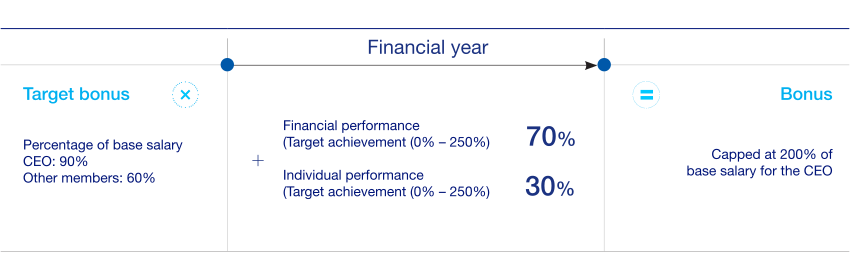
The Short-term Incentive Plan (bonus plan) involves a cash payment after the financial year ends, based on predefined objectives. These objectives measure both financial and individual performance for each Executive Committee member. The target bonus is a percentage of the annual base salary: 90% for the CEO and 60% for other members.
The general functionality of the bonus plan is as follows. For all Executive Committee members, the bonus plan objectives are divided into two categories: “Financial performance” and “Individual performance.”
Functionality of the bonus plan
The performance is assessed based on the following appraisal process:
|
Performance appraisal |
||
|
Step |
|
Description |
|
Step 1: Target setting |
|
Definition of two to four individual performance objectives at the beginning of the year |
|
Step 2: Performance assessment |
|
Performance assessment at the end of the year |
|
Step 3: Compensation determination |
|
Determination of incentive payouts on the basis of the company’s or division’s performance and achievement of the individual objectives |
The financial targets used in the bonus plan as of 2025 are changed to the figures as reported in the annual report to better align with our Sulzer 2028 strategy and provide transparent disclosure in line with the Annual Report to our shareholders. In addition, in order to further emphasize the aim to increase profitability, which forms a central pillar of our Sulzer 2028 ambition, the weighting of the profitability objective, EBITDA-Margin (of sales), was increased by 5%.
Details of these changes are shown in the following table.
|
Target setting financial objectives |
||||||||||
|
Category |
|
Objectives 2024 |
|
Weighting 2024 |
|
Rationale of change |
|
Objectives 2025 |
|
Weighting 2025 |
|
Financial performance |
|
Operational profitability |
|
25% |
|
Alignment to financial reporting and fostering entrepreneurial spirit of the Executive Committee |
|
EBITDA-margin (of sales) |
|
30% |
|
|
Sales |
|
25% |
|
Alignment to market practice and Sulzer 2028 strategy |
|
Sales growth |
|
20% |
|
|
|
Operational operating net cash flow (operational ONCF) |
|
20% |
|
Alignment to financial reporting and market standards |
|
Operating Net Cash Flow (ONCF) |
|
20% |
|
The individual performance targets remained unchanged:
|
Target setting individual objectives |
||||||
|
Category |
|
Objectives |
|
Target |
|
Weighting |
|
Individual performance |
|
Sulzer Excellence |
|
Objectives that increase efficiency, reduce unnecessary complexity and drive cross-functional collaboration resulting in advanced competitiveness and profitability. |
|
10% |
|
|
Sulzer 2028 |
|
Objectives that contribute to the ambition of being a top industrial company with future-proof, differentiated, high-quality business. |
|
10% |
|
|
|
Sustainable Sulzer |
|
Objectives linked to the three major priorities of Sulzer’s sustainable plan, namely minimizing our carbon footprint, enabling a low carbon society and engaging our employees and communities. |
|
10% |
|
The objectives for the bonus plan are linked to Sulzer’s strategic goal of promoting the sustainable and profitable growth of the company as shown below.
|
Strategic link of bonus plan |
||||||
|
Objective |
|
Growth |
|
Profitability |
|
Long-term shareholder-value creation |
|
Bonus plan |
|
|
|
|
|
|
|
|
|
|
|
|
|
|
|
EBITDA-margin (of sales) |
|
|
|
|
|
|
|
Sales growth |
|
|
|
|
|
|
|
Operating Net Cash Flow (ONCF) |
|
|
|
|
|
|
|
Sulzer Excellence |
|
|
|
|
|
|
|
Sulzer 2028 |
|
|
|
|
|
|
|
Sustainable Sulzer |
|
|
|
|
|
|
Target achievement under the bonus plan
For each financial objective, parameters are set in advance. An expected performance level (“target”) results in a 100% payout factor. A minimum performance level (“threshold”) is defined, below which the payout factor is zero, and a maximum performance level (“cap”) is set, above which the payout factor is capped. The payout factor is interpolated linearly between the threshold and target, and between the target and cap.
The CEO’s, CFO’s and CHRO’s financial objectives are measured 100% based on Sulzer group results. To better enable the One Sulzer culture and to align with common market practice, the measurement of the financial objectives for Division Presidents was changed to 50% based on group results and 50% on their respective division results.
Each Executive Committee member receives personal objectives aligned with the Sulzer 2028 ambition in three performance categories: “Sulzer Excellence,” “Sulzer 2028” and “Sustainable Sulzer” at the start of the financial year. The CEO reviews the individual performance of each Executive Committee member based on their personal objectives, and this review is then evaluated by the RC. The Lead Independent Director, in close consultation with the Chair of the RC, assesses the CEO’s individual performance.
A payout factor is determined for each objective based on actual performance. The weighted average of these payout factors is multiplied by the target bonus amount to calculate the actual bonus, which is paid out in March of the following year.
Sulzer strives for transparency in relation to pay-for-performance. To ensure transparency while avoiding competitive risk, Sulzer provides a general performance assessment for each financial objective as well as the aggregated individual performance at the end of the performance cycle.
In 2025, the bonus plan target achievement for the financial performance was as follows:
Bonus plan target achievement
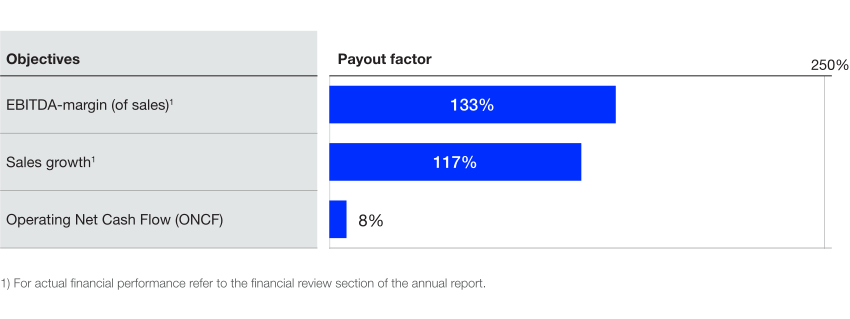
For 2025, the financial component of the bonus averaged at 98%. While 2025 was another year with strong results for the Group, the target achievement is below 100% due to the ambitious targets which were set intentionally at a stretch level in line with our Sulzer 2028 ambition. The unforeseen development arising from US tariffs and increasing geopolitical tensions led to postponements of larger customer investments which impacted our businesses in Flow and Chemtech to grow more ambitiously as planned for the targets in 2025.
Overall, the combined financial and individual performance resulted in a bonus payout factor ranging from 90% to 140% (average 124%) for Executive Committee members.
Performance share plan (PSP)
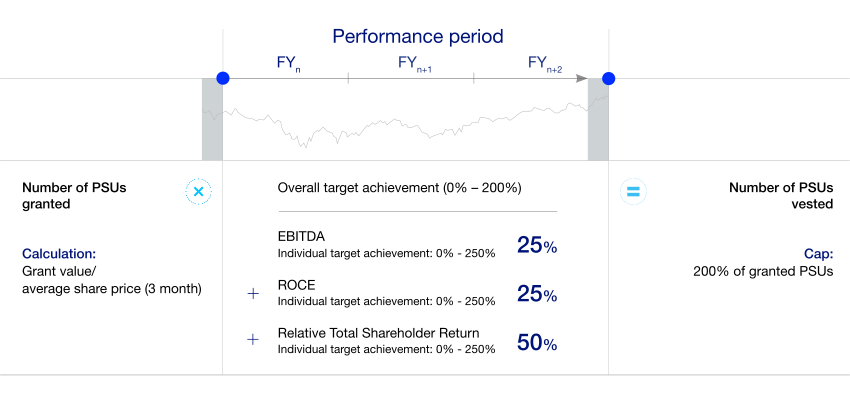
The Performance Share Plan (PSP) incentivizes long-term shareholder value creation by granting performance share units (PSUs) to Executive Committee members. PSUs are conditional rights to company shares, subject to achieving strategic/financial targets at the Group level over a three-year period.
The PSP aligns participants’ interests with shareholders by delivering a substantial portion of compensation as company equity. This supports Sulzer’s focus on pay-for-performance, sustainable growth, and employee retention. It is a fair and attractive element of long-term variable compensation for key management, emphasizing excellent, sustainable performance.
In line with the Sulzer 2028 strategy and in order to drive and reward above-market growth, improved margins, and top level revenue, the structure and underlying performance objectives of the PSP were revised for 2025 and going forward.
The number of PSUs granted is calculated by dividing the grant value by the three-month volume-weighted average share price before the grant date. The grant value of the PSP in 2025 and going forward is defined as a percentage of base salary which reflects the executive’s role. The PSP grant in 2025 and going forward amounts to:
- Chief Executive Officer: 120% of base salary
- Members of the Executive Committee: 95% of base salary
The fundamental change in the grant methodology serves to align the grant levels amongst all the Executive Committee members to provide equal incentivization amongst them. The slight increase in the grant levels which accompanied this harmonization also brought the levels of the long-term compensation closer to the lower end of the market as defined by the compensation benchmarking while strengthening the alignment of the Executive Committee with the long-term success of the company.
In order to ensure a more transparent link between pay and performance, as well as to reduce the complexity of the PSP overall, the adjusted KPIs Operational Profit and Average Operational ROCEA were replaced in favor of EBITDA and ROCE, respectively. In doing so the performance objectives measured in determining the PSP target achievement are now aligned with those reported in the financial statements. Moreover, the PSP performance objectives are aligned with Sulzer’s overall strategic goal of promoting sustainable and profitable growth and with the Sulzer 2028 strategy in particular. They are designed to incentivize growth and create shareholder value.
The following table outlines the performance objectives for the 2025 PSP.
|
Key performance criteria measured over the three-year performance period of the PSUs |
||
|
EBITDA |
|
Earnings before interest, tax, depreciation, amortization and impairment, based on audited figures. This is an absolute value reflecting the planned value in the last year of the performance period. |
|
ROCE |
|
Adjusted returns on capital employed. This is a percentage reflecting the planned value in the last year of the performance period. |
|
Relative Total Shareholder Return |
|
Relative Total Shareholder Return (TSR) is defined as share price growth plus dividends during the vesting period divided by the ending share price, measured against peers. |
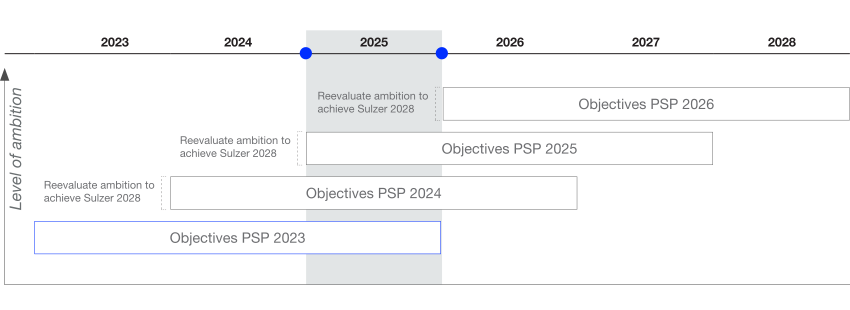
The performance objectives for the PSP tranches are determined yearly on the basis of the three-year plan for the respective financial year, which in turn is generally aligned with the overall aims and objectives of the Sulzer 2028 ambition. Consequently, the PSP objectives are designed to incentivize growth and create shareholder value due to their long-term outlook aligned with the Sulzer 2028 ambition. Moreover, as illustrated in the graphic below, following financial years in which the actual company performance fell short of the planned objectives, the alignment of the three-year plans on which the PSP objectives are based with the Sulzer 2028 ambition leads to an even stronger incentivization of the long-term growth as the objectives are set at a more ambitious level to ensure that the Sulzer 2028 ambition can still be achieved.
Determination of objectives
The link between the individual selected objectives of the Performance Share Plan and each individual element of the Sulzer 2028 ambition is shown below:
|
Strategic link of PSP |
|
|
|
|
|
|
|
|
|
Growth |
|
Profitability |
|
Long-term shareholder value creation |
|
PSP |
|
|
|
|
|
|
|
|
|
|
|
|
|
|
|
EBITDA |
|
|
|
|
|
|
|
ROCE |
|
|
|
|
|
|
|
Relative TSR |
|
|
|
|
|
|
Functioning of the PSP Performance at a glance
Target achievement under the Performance Share Plan
In addition to the changes made to the applicable performance objectives in the PSP, the calculation of the target achievement and subsequent payout from the LTI was changed with the 2025 PSP grant. The additional maximum payout cap of 250% of the grant value on top of the 250% cap on target achievement of the performance objectives was removed. To compensate for the potentially higher upside resulting from removing this cap, the maximum number of units which may vest at the end of the performance period was reduced from 250% to 200%. These changes ensure that the pay of the Executive Committee members is better aligned with the performance of both the key internal financial figures as well as the Sulzer share price and thus the alignment between the plan participants and the shareholders.
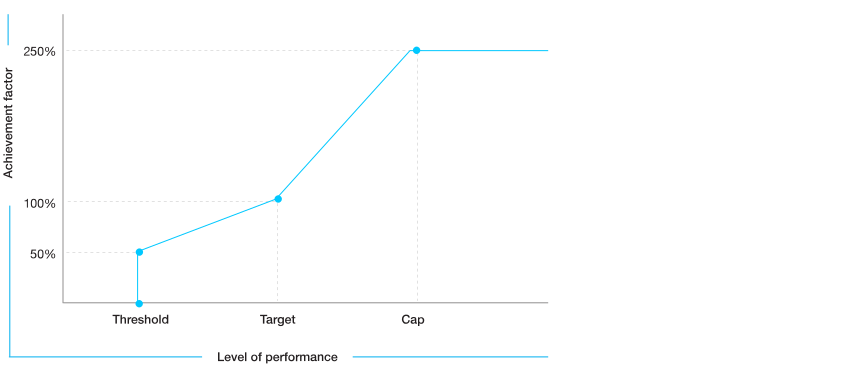
An expected performance level (“target”) is defined for each PSP performance objective, resulting in a 100% target achievement. A minimum performance level (“threshold”) is set, below which the target achievement is zero, and a maximum level (“cap”) is set, capping the target achievement at 250%. The target achievement is interpolated linearly between the threshold and target, and between the target and cap. At the end of the performance period the target end achievement of each individual performance objective is calculated to determine the weighted average of the overall target achievement of the PSP which is capped at 200%
The target achievement can be illustrated in a target achievement curve as follows:
Target achievement curve of the PSP performance conditions
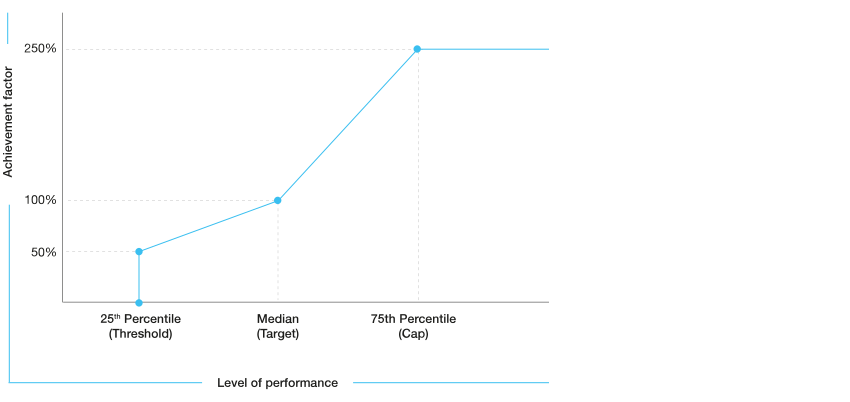
Relative total shareholder return (TSR) is measured based on the performance against a predefined peer group of international peers, measured as a percentile ranking, aligned with the target achievement curve as follows:
- Threshold: 25th percentile ranking
- Target: median ranking
- Outperformance (cap): 75th percentile ranking
The target achievement curve of the relative TSR can be illustrated as follows:
Target achievement curve of the relative TSR
The current peer group for the measurement of the relative TSR consists of the following companies:
|
Peer group for relative TSR performance of PSP 2025 |
||||||||
|
Andritz |
|
Burckhardt Compression |
|
Ebara |
|
Flowserve |
|
Georg Fischer |
|
ITT |
|
OC Oerlikon |
|
Pentair |
|
Rieter 1) |
|
Xylem |
1) Wood Group was replaced by Rieter due to its trading suspension and takeover in 2025.
The Board of Directors can change the peer group composition if necessary, such as in cases of mergers, acquisitions, delistings or significant business changes in a peer company. In such situations, the Board will select new peer companies from a predefined successor list.
Provisions at termination of employment
In the event of termination of employment, the following provisions apply:
|
Provisions by the event of termination |
||
|
Type of termination |
|
Provision |
|
By the employer for cause |
|
Unvested PSUs are forfeited. |
|
As a result of retirement |
|
Vesting and performance measurement of PSUs continues according to plan, no early allocation of the shares. |
|
Any other reason |
|
The number of unvested PSUs vest on pro rata basis according to the achievement factor at the end of the vesting period. There is no early allocation of the shares. |
In the event of an Executive Committee member’s death, pro-rated PSUs will vest immediately, pending a performance assessment by the Board of Directors. If a change of control occurs, PSUs will also vest immediately, subject to the Board’s performance assessment. The Board may opt for a cash settlement of the awards in such cases.
PSP 2023 performance and vesting
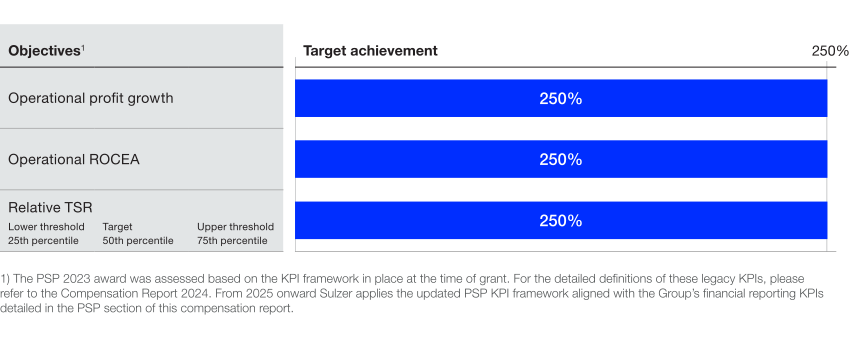
The overall target achievement of the PSP 2023 depends on the objectives operational profit growth, operational ROCEA and relative TSR over the performance period. Over the past three years, Sulzer significantly grew its operational profit through the Sulzer 2028 strategy and leveraged strong market momentum in 2025. This performance resulted in an achievement factor of 250% compared to the original PSP target set by the Board.
Operational ROCEA also achieved a factor of 250%, thanks to continuous profitability improvements and better capital management through the Sulzer 2028 strategy.
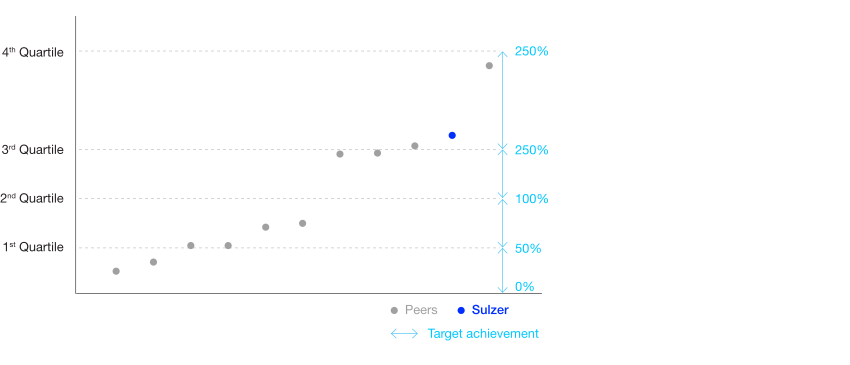
The Sulzer share performed strongly in uncertain economic conditions over the previous 3 years, especially compared to Sulzer’s peers. As a result the development of Sulzer’s TSR is positioned at the 90th percentile compared to international peers, leading to an achievement factor of 250% for the relative TSR. The performance of Sulzer’s TSR and the TSR of the peers over the 3-year performance period of the PSP 2023 is shown below:
TSR positioning of Sulzer with the peer group of PSP 2023
The weighted average of the achievement factors of the three individual performance objectives of the PSP 2023 results in a total payout factor of 250% for the PSP 2023, subject to the original grant value cap. The payout of the PSP 2023 was based on targets set prior to the redesign of the LTI in 2025.
PSP target achievement
Overall, the PSP vesting levels accurately reflected operational performance, also against direct peers, over the three-year cycle.
On the vesting date, the number of vested PSUs is calculated by multiplying the initial PSUs granted by the weighted average achievement factor. Each vested PSU results in one Sulzer share for the participant.
Finally, for PSP grants prior to 2025, the number of vested PSUs is capped at 250% of the original grant value. After applying this cap, the overall payout factor for the PSP 2023 is reduced to 143%.